
The Most Powerful Laser Pointer? What Milliwatts and Laser Classes Really Mean
Searching for the most powerful laser pointer? Before you compare milliwatts, learn what the number means, how laser classes work and why colour matters as much as power.
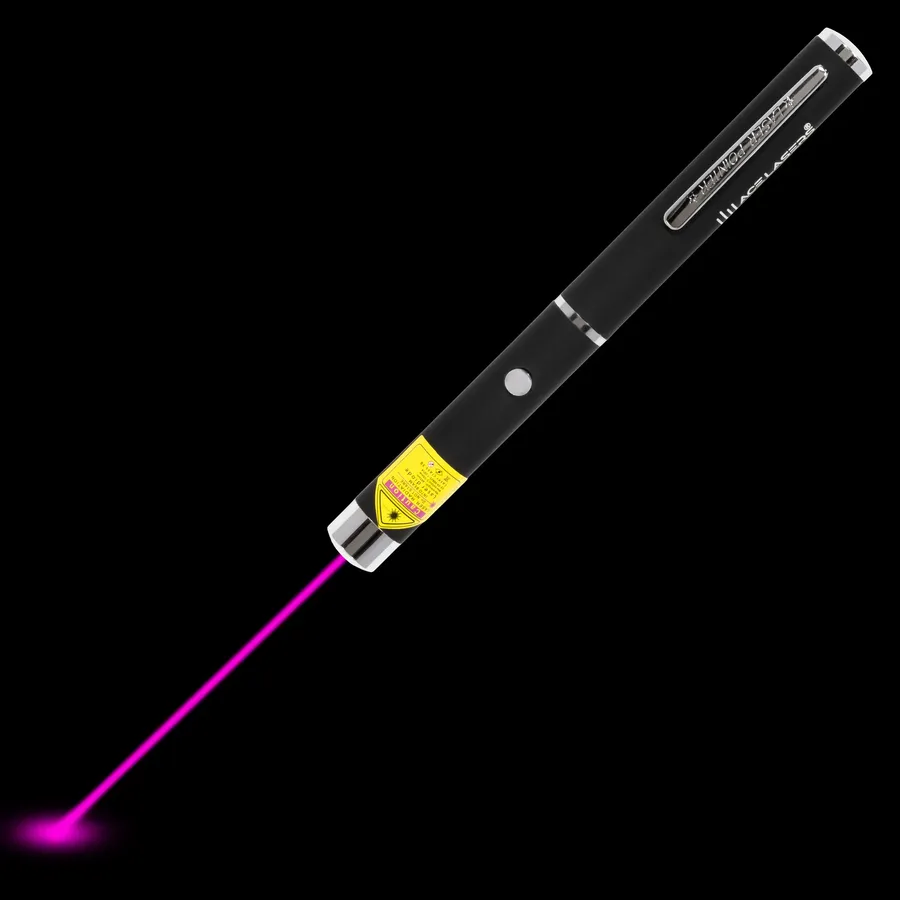
"Most powerful laser pointer" and "highest power laser pointer" are among the most searched laser terms in the UK. That is understandable: if you want to move geese off a 20-acre field or point out a faint star to a group of fifty, you want something that clearly works. But the number on the box only tells part of the story. In this article we explain what milliwatts mean, how laser classes are defined, why colour changes everything and how to choose the right power for your task, not simply the highest number.
What a milliwatt (mW) actually measures
The output of a laser pointer is expressed in milliwatts (mW): thousandths of a watt of light energy leaving the aperture. It describes how much optical power is in the beam, not how bright it looks and not how far it reaches. A typical presentation pointer stays below 1 mW. Our ACE pen-style lasers deliver 5–50 mW, our Pro models 50–500 mW, and the VEX-1000 Pro is a 500 mW high-power professional laser.
More milliwatts means more light in the dot, which makes it visible in brighter conditions and over greater distances. It also means a greater hazard to the eye. That relationship is the core of every laser safety rule: the more power, the more care.
Laser classes in plain English
Lasers are classified under the international standard IEC/EN 60825-1 according to the hazard they present. Simplified:
| Class | Typical output (visible) | What it means |
|---|---|---|
| Class 1 | Very low | Safe under normal use; found inside devices such as printers. |
| Class 2 | Below 1 mW | The blink reflex normally protects the eye from brief exposure. Typical presentation pointer. |
| Class 3R | Up to 5 mW | Small risk; direct viewing should be avoided. |
| Class 3B | Up to 500 mW | Direct beam and specular reflections are hazardous to the eye. Requires precautions and safety eyewear. |
| Class 4 | Above 500 mW | Hazardous to eyes and skin, also via diffuse reflections; fire risk. |
ACE pen-style and Pro lasers are class 3B. By definition, a class 3B laser cannot exceed 500 mW. That gives you a useful reality check when you see listings online advertising pen lasers of 5,000, 10,000 or even 50,000 mW: figures far beyond what any stated class allows deserve scepticism. We state our output ranges as they are, and we do not sell lasers intended for burning.
Why colour matters as much as power
The human eye is not equally sensitive to every colour. In daylight it is most sensitive to green-yellow light, around 555 nm. Green lasers at 532 nm are close to that peak, which is why a green dot looks several times brighter than a red dot of the same output. Violet at 405 nm sits at the edge of human vision: the dot looks dim, even though the power in the beam is the same.
The practical result is visible in our indicative range figures:
| ACE Pro laser, 50–500 mW | Daylight | Dusk | Dark |
|---|---|---|---|
| Green (532 nm) | approx. 500 m | approx. 2 km | Beam clearly visible, up to approx. 5 km |
| Red | approx. 200 m | approx. 1 km | approx. 2 km |
| Violet (405 nm) | approx. 50 m | approx. 300 m | approx. 1 km |
So the VEX-1000 Pro at 500 mW violet is not the most visible laser in our range; a green AGP-3 Pro reaches further. If visibility is your goal, choose green first and decide on power second.
Dot versus beam
Two different things are visible with a laser. The dot is where the light hits a surface: that is what birds react to and what you use to mark a target. The beam is the line through the air, made visible by dust and moisture scattering a little of the light. You only see the beam in the dark or at dusk, and much better with green than with red. Astronomy guides rely on the beam; bird control relies on the dot.
How much power do you really need?
- Pointing out stars under a dark sky: 5–50 mW green is enough for most groups. The AG-1 is the usual choice. See lasers for astronomy.
- Bird control at dusk on smaller sites: 5–50 mW green can work; for large fields 50–500 mW gives the reserve you need. See laser bird scaring.
- Daylight work or long distances: a high power green laser pointer with 50–500 mW.
- Fluorescence and specialist work: violet, at the power your application requires.
The principle we recommend to every customer: use the lowest power that does the job. A lower-powered laser is easier to control, more forgiving of mistakes and less likely to cause harm through a reflection you did not expect.
More power, more responsibility
A class 3B laser can injure the eye in a fraction of a second, faster than you can blink. Reflections from glass, water, metal and glossy paint can be just as hazardous as the direct beam. That is why high power always comes with rules:
- Never aim at people, at the eyes of animals, at vehicles or at aircraft.
- Never aim into the sky near flight paths, and switch off immediately when an aircraft approaches.
- Wear goggles rated for the wavelength; see our laser safety glasses guide.
- Keep the laser away from children, remove the safety key (where fitted) during storage and keep it locked away.
- Only use high-power lasers outdoors with a controlled background.
ACE lasers are sold to adults 18+ and to businesses. Rules on owning, carrying and using lasers vary by situation; as the buyer you are responsible for complying with UK law. Our laser safety guide covers the practical side.
Summary
The most powerful laser pointer is not automatically the best one. Output in mW tells you how much light is in the beam; colour decides how bright it looks; conditions decide how far you can see it. For most professional outdoor uses a green laser is the starting point, with 5–50 mW for night-time pointing and 50–500 mW for daylight and large areas. Browse our high powered laser pointers or start with the laser finder if you are unsure.
More articles
Blog
Laser Safety Glasses: How to Choose Goggles for a Class 3B Laser Pointer
Laser safety glasses are essential with a class 3B laser. Learn how wavelength ratings and optical density wor…
Laser Bird Deterrent on Farms: Planning a Routine Through the Seasons
How farmers and land managers use a green laser as a bird deterrent across large areas: species, timing throug…
High-Power Laser Range: How Far Green, Red and Violet 5–500 mW Lasers Reach
How far a high-power laser reaches depends on output, colour and conditions. We compare green, red and violet…