
High-Power Laser Range: How Far Green, Red and Violet 5–500 mW Lasers Reach
How far a high-power laser reaches depends on output, colour and conditions. We compare green, red and violet ACE lasers in daylight, at dusk and in the dark, and explain the difference between dot and beam.
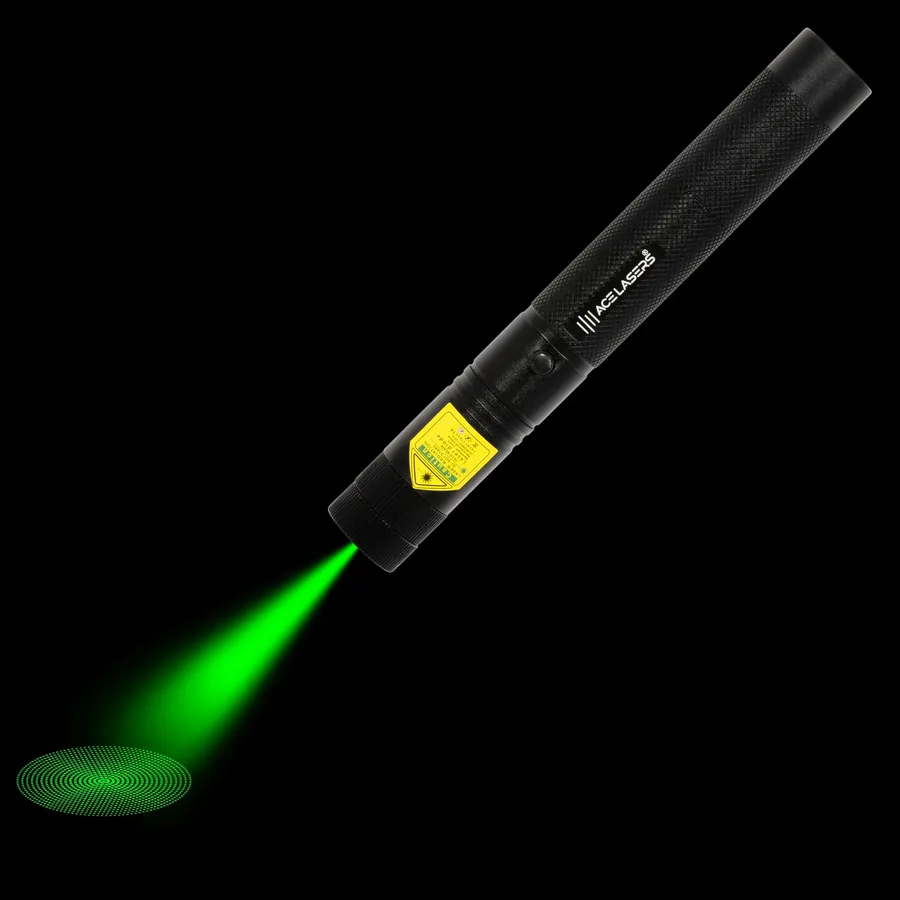
"How far does a high-power laser reach?" sounds like a simple question. Strictly speaking, the light from a laser travels on until something absorbs or scatters it. What you really want to know is how far away you can still see the dot or the beam, and that depends on three things: output, colour and conditions. This article compares the colours in our range, gives indicative figures and explains what changes them in practice.
Dot range versus beam visibility
There are two ways to see a laser. The dot is the spot of light on a surface: a field, a wall, a tree. Dot range is what matters when you mark a target or move birds. The beam is the line of light through the air, visible because dust and water droplets scatter a little of the light towards you. You see the beam only at dusk and in the dark, and far better with green than with any other colour. Astronomy guides use the beam; most outdoor work uses the dot.
Factor 1: output
More output puts more light into the dot, so it stays visible in brighter surroundings and over longer distances. Our pen-style lasers deliver 5–50 mW, the Pro models 50–500 mW. The step from pen-style to Pro roughly doubles the visible range, and sometimes more, as the table below shows. Read more in what milliwatts really mean.
Factor 2: colour
The eye is most sensitive to green-yellow light. A green laser at 532 nm is close to that peak, so its dot looks several times brighter than a red dot of the same output. Violet at 405 nm is at the edge of human vision and looks the dimmest. That is why, in our range, green always reaches furthest and violet least far, even at equal power.
Indicative range by colour and output
| ACE laser | Output | Daylight | Dusk | Dark |
|---|---|---|---|---|
| Green Pro (AGP-1, AGP-2, AGP-3) | 50–500 mW | approx. 500 m (dot on objects) | approx. 2 km | Beam clearly visible, up to approx. 5 km |
| Green pen-style (AG-1, AG-2) | 5–50 mW | approx. 200 m | approx. 1 km | approx. 2 km, beam visible |
| Red Pro (ARP-1, ARP-2) | 50–500 mW | approx. 200 m | approx. 1 km | approx. 2 km |
| Red pen-style (AR-1) | 5–50 mW | approx. 100 m | approx. 500 m | approx. 1 km |
| VEX-1000 Pro (violet) | 500 mW | approx. 100 m | approx. 500 m | approx. 2 km |
| Violet Pro (AVP-1, AVP-2) | 50–500 mW | approx. 50 m | approx. 300 m | approx. 1 km |
| Violet pen-style (AV-1) | 5–50 mW | approx. 30 m | approx. 150 m | approx. 500 m |
Two things stand out. A green pen-style laser of 5–50 mW reaches as far as a red Pro laser of 50–500 mW. And a 500 mW violet laser is visible over a shorter distance than a green Pro laser. If range is your priority, colour is the first decision.
Factor 3: conditions
Ambient light
The darker the surroundings, the more the dot stands out. In bright sun even a powerful laser dot is hard to see at a distance; at dusk the same dot can be seen several times further away. That is why bird control and long-range signalling are most effective at dawn and dusk.
Weather and air
Haze, mist, drizzle and smoke scatter light. That makes the beam more visible near you, but weakens the dot at a distance. On very clear, dry nights the beam is fainter, but the dot travels further. Humid air on a dark night gives the most striking beam.
Surface
A dot on a light, matt surface such as a pale wall, dry grass or a road sign is more visible than one on dark soil or dense foliage. Shiny surfaces are a different matter: water, glass and metal reflect the beam in unpredictable directions and must be avoided for safety reasons.
Your eyes
Eyes adapted to the dark see far fainter dots than eyes that have just looked at a phone screen or headlights. Give your eyes time when working at night.
Red vs green laser: which should you choose?
For most outdoor uses, green. It is visible further at the same output, its beam is visible at night and birds respond well to it. Red is worth choosing when you specifically want a red dot, for example for contrast against green vegetation or as a second signalling colour alongside green. Violet is for fluorescence and specialist uses, not for range.
- Longest range: high power green laser pointers
- Night-time pointing with a visible beam: AG-1 green laser pen
- Red dot: ARP-1 Pro or AR-1
- All three colours: pen-style set or Pro set
Range is not the same as a safe distance
A laser that is visible over kilometres is also hazardous over a long distance. Glare and flash blindness can affect a driver or pilot far beyond the point where eye injury is likely, and that can be just as dangerous. Never aim a laser at people, the eyes of animals, vehicles or aircraft, never into the sky near flight paths, and always know what lies behind your target. Wear goggles rated for your laser's wavelength and keep the laser away from children. As the buyer you are responsible for complying with UK law. Read our laser safety guide.
Summary
How far a high-power laser reaches depends on output, colour and conditions. Green reaches furthest; dusk and darkness multiply the visible range; and every figure is indicative. For practical advice by task, see our pages on long range laser pointers, bird scaring and astronomy, or let the laser finder suggest a model.
More articles
BlogThe Most Powerful Laser Pointer? What Milliwatts and Laser Classes Really Mean
Searching for the most powerful laser pointer? Before you compare milliwatts, learn what the number means, how…
Laser Safety Glasses: How to Choose Goggles for a Class 3B Laser Pointer
Laser safety glasses are essential with a class 3B laser. Learn how wavelength ratings and optical density wor…
Laser Bird Deterrent on Farms: Planning a Routine Through the Seasons
How farmers and land managers use a green laser as a bird deterrent across large areas: species, timing throug…