HalloweenUse code HALLOWEEN5 for 5% off, valid until 31 October.

Order on a weekday before 3 pm (UK time) = shipped today Free shipping from £50.00 with trackingBatteries included
Need advice?support@acelasers.com
Cart
Shop by use

Laser Pointers for Astronomy Clubs and Stargazing Guides

On a dark night the beam of a green laser seems to reach right up to the stars, so everyone in a group can see exactly which star you mean. Astronomy clubs, outreach volunteers and stargazing guides use it at public evenings and dark-sky events. Here is how to choose a laser for this and how to use it responsibly.

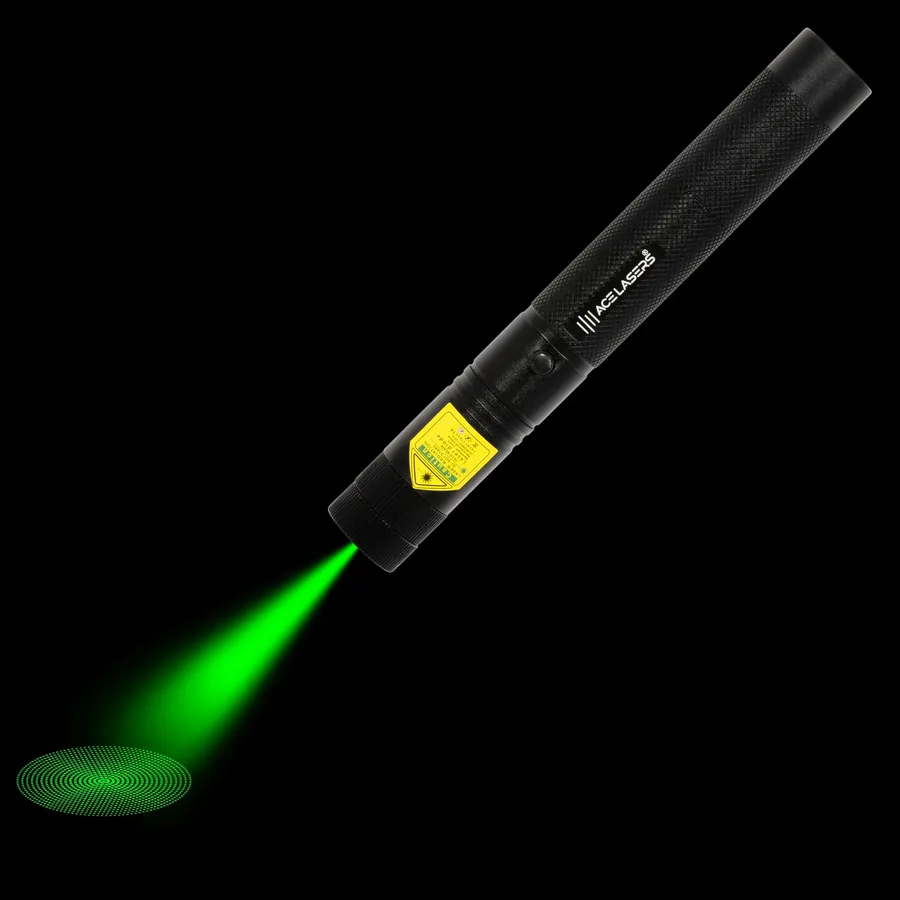
ACE Lasers AG-1 strong green laser pen 5–50 mW on AAA batteries
Our advice for you · Pointing out stars
ACE Lasers AG-1304× sold

ACE Lasers AG-1 Green Laser Pen (5–50 mW)

Strong green laser pen on two AAA batteries: no charging, beam visible at night.

  • Green 532 nm, 5–50 mW, laser class 3B
  • Beam visible at night, dot up to approx. 2 km in the dark (indicative)
  • Runs on 2 × AAA batteries, included
£29.95£24.95
In stock · Order on a weekday before 3 pm (UK time) = shipped today
Details
Pointing out stars

Also a good match

Laser finder

Why green lasers are used in astronomy

When you say "that bright star just left of the moon", everyone looks somewhere else. A green laser solves that instantly. In dark, slightly humid air the beam scatters a little light along its path, so the group sees a green line that starts at your hand and appears to end at the star you are pointing at. Green at 532 nm is the colour the eye sees best at night, which is why it is the standard for star pointing; red and violet beams are far harder to see.

How much power do you need?

Less than many people think. Under a properly dark sky, a pen-style laser of 5–50 mW shows a clear beam and is the sensible choice for most club and outreach evenings. More power makes the beam more visible under light-polluted skies or for very large groups, but also increases the hazard and the responsibility. Use the lowest power that does the job.

  • AG-1 green laser pen (5–50 mW, 2 × AAA): our first choice for star pointing. Simple, no charging, beam visible at night, dot indicatively up to approx. 2 km in the dark.
  • AG-2: the same, with pattern cap for short-range use; remove the cap for star pointing.
  • AGP-3 Pro (50–500 mW): for experienced guides at large public events or under skies with light pollution, where a brighter beam is needed. Beam clearly visible, indicatively up to approx. 5 km.
  • AGP-2 Pro Mini: the compact Pro option for guides who also lead walks.

Running a session with a laser

  1. Brief the group before you start: only the guide uses the laser, nobody looks into it, and you will switch it off whenever an aircraft is near.
  2. Check the sky. Look for aircraft lights, helicopters and drones before every use. Do not use a laser near airports or under approach and departure routes.
  3. Short bursts only. Point, name the object, switch off. A continuous beam distracts and increases risk.
  4. Point high, never low. Keep the beam well above the horizon, trees and buildings, and away from people at the edge of the group.
  5. Combine with binoculars and telescopes. Point out a target with the laser, then let the group find it in the eyepiece. Never shine a laser through a telescope or binoculars.

Our blog post how to run an astronomy outreach evening with a laser works through a full evening programme.

Practical tips

  • Cold nights drain batteries faster. Keep the laser and spare cells in an inside pocket; with Pro models carry a charged 18650 or 16340 spare.
  • Keep the laser in a fixed pocket so you can find it in the dark without using a torch.
  • For club equipment, record who holds the laser and store it locked, with the key removed where fitted.

Safety

A laser pointer is never aimed at aircraft, helicopters, drones, vehicles or people. If an aircraft appears, switch off immediately and wait until it has passed well clear. Keep the laser away from children and wear goggles rated for 532 nm when setting up or demonstrating. As the buyer you are responsible for complying with UK law. Please read our laser safety guide.

Frequently asked questions

Which laser pointer is best for astronomy?
A green laser. For most club evenings under a dark sky the AG-1 (5–50 mW) is sufficient; experienced guides at large events may use the AGP-3 Pro.
Why can I see the beam of a green laser at night?
Particles and moisture in the air scatter a little of the light along the beam. Green is the colour the eye sees best in the dark, so the beam becomes visible.
What should I do if an aircraft approaches?
Switch off immediately and wait until it has passed well clear. Never aim a laser at or near aircraft.